
How to Choose a Cat Litter Manufacturer for Your Brand
Most cat litter suppliers look identical on a quote sheet. The same five litter types, a similar FOB price, the same promise of free samples. The differences that decide whether your brand still has stock in month eighteen are not on that sheet, which is why choosing a cat litter manufacturer comes down to five questions most buyers never ask.
This guide covers the litter types and which market each one wins, the production details worth inspecting, and a sample-testing method you can run yourself before you commit to a container.
What your customer is actually testing
Before judging a supplier, it helps to know what the person opening your bag is judging. Retail buyers and cat owners converge on four things, in this order:
- Does it clump and hold? A clump that breaks on the scoop is the fastest route to a one-star review.
- How much dust comes out? Dust is visible in a dark room and in a phone camera flash. It is the most photographed complaint in the category.
- Does the smell come back? Odour control is judged at day three, not day one.
- Does it track? Fine granules travel on paws and end up on beds.
None of these are marketing claims. They are repeatable observations, which means a supplier either controls them in production or hopes you will not test.
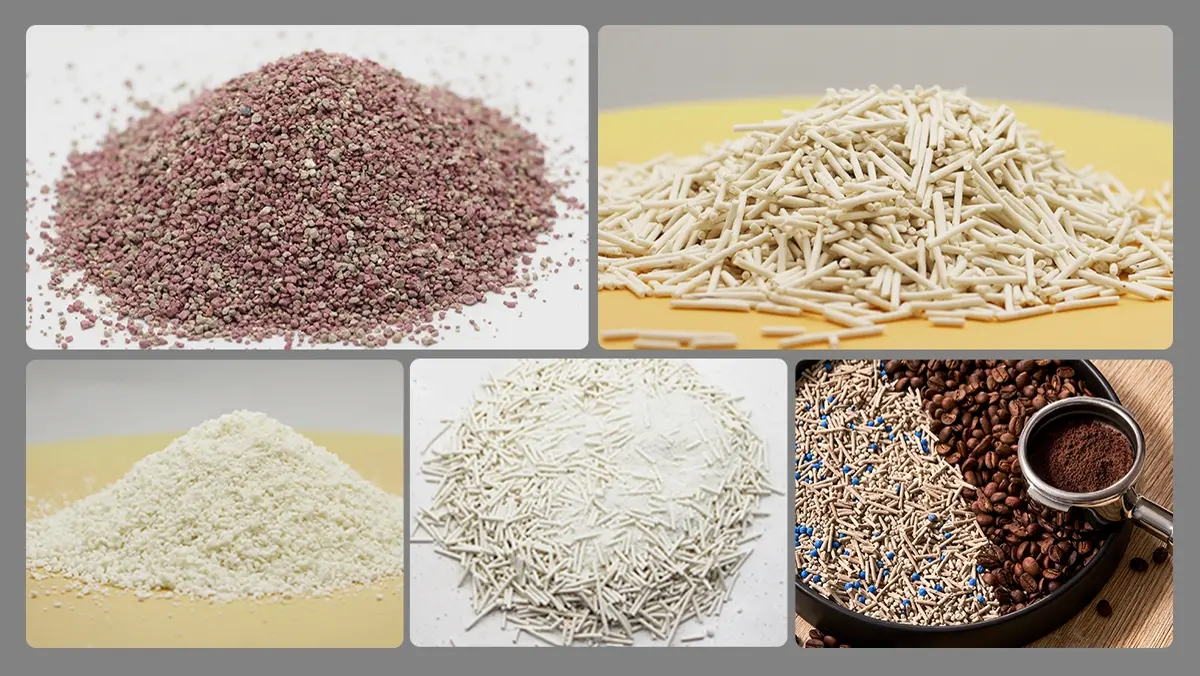
The five litter types, and which market each one wins
| Sodium bentonite | Tofu (pea fibre) | Cassava | Mixed blends | Specialty | |
|---|---|---|---|---|---|
| Clumping | Hardest, heaviest clumps | Firm, lighter | Firm, soft texture | Tuned by ratio | Varies by base |
| Dust | Low when dedusted properly | Low, needs electrostatic control | Low | Inherits the mineral share | Varies |
| Odour control | Ammonia binding via ion exchange | Moderate, depends on additives | Moderate | Mineral share carries it | Depends on additive |
| Flushable | No | Yes | Yes | Only plant-heavy blends | Depends |
| Weight per litre | Heaviest - highest freight cost | Light | Light | Mid | Varies |
| Moisture risk in container | Low | High - the main failure mode | High | Mid | High |
| Best fit | North America, Middle East, Russia | Japan, Korea, Southeast Asia | Premium EU, eco-positioned brands | Markets wanting plant story plus mineral performance | Brands needing a differentiated SKU |
Three things that table does not show:
Weight is a margin decision, not a product decision. Bentonite is roughly twice the density of tofu litter. On a 20-tonne container, that changes how many litres you land per dollar of freight - which is why cost per litre, not cost per tonne, is the number to negotiate on.
Mixed litter is the fastest-growing request, and the hardest to make. A blend is only as good as the plant half. If the tofu component crumbles, the mineral half cannot save the clump.
Cassava is not a cheaper tofu. It is positioned as a premium alternative in most European markets, and pricing it like tofu gives away margin.
What separates one manufacturer from another
Does it own the ore, or buy it?
A trader can quote a lower price in month one and a higher one in month six, because the ore price is not his to control. Ask directly: do you hold the mining rights, or buy from a mine? Then ask what happens to your price when ore costs move.
MIYA's sodium bentonite comes from our own deposit in Balikun, Xinjiang, and is processed in our own plant in Zhengzhou. That is why a spec change reaches the line in days, and why volume commitments mean something.
How is dust controlled - during production, or after?
There are two ways to hit a dust figure. One is to run dedusting during granulation and screening, so fines never enter the bag. The other is to sift the finished product and hope.
Ask which stage the dust removal happens at, and ask for the method behind the percentage. A dust number without a method is a marketing number.
What is the finished moisture, and how is it held?
This is the detail that breaks plant-based litter in ocean freight. A bag that leaves the plant at the top of its moisture band will sweat in a container crossing the equator, and the customer opens a mouldy bag six weeks later.
Ask for the target moisture range and the measurement point - at the dryer, or after cooling. The answer tells you whether the supplier has shipped this product before.
Can it hold a batch, or only a sample?
A sample is made by hand, or pulled from the best run of the month. Production is a different animal. Ask how granule size is screened, how weight is checked, and whether a batch record travels with the container.

Eight questions to ask before a trial order
- Do you hold the mining rights for your bentonite, or buy ore?
- At which production stage is dust removed, and what method produces your dust figure?
- What is your target finished moisture, measured where?
- What is your granule size tolerance, and how is it screened?
- What is the real MOQ for a private label run, including packaging?
- Who owns the bag artwork and the printing plate, and what happens to it if we stop ordering?
- Which certificates do you hold, and can I see the report matching the number on your spec sheet?
- Can I book a factory audit or a live video walkthrough before payment?
A supplier who answers all eight without forwarding you to a sales manager is a supplier worth a trial container.
How to test a sample like a buyer, not a customer
Most buyers judge a sample by scooping it once and forming an impression. That is not a test. Run these five, with the same conditions for every supplier you compare:
- Clump time. Fixed litter weight, fixed water volume, timer running. Lift at a set time and see whether the clump holds its shape.
- Absorption. Same mass, measured water. Record millilitres absorbed per 100g, not a percentage with no basis.
- Dust. Pour from a fixed height onto a dark plate under a fixed light. Weigh what settles.
- Odour. Sealed container, fixed contact time, and someone who did not choose the litter. Report the verdict, not the intent.
- Tracking. A standard tray and a fixed walk path. Count granules carried out per exit.
Do this for three suppliers and the quote sheet stops being the deciding document. See how we run these tests on camera →
The cost question buyers ask last, and should ask first
Price per tonne hides three costs: freight per litre, damage and returns, and the cost of switching suppliers mid-season.
A cheaper bentonite at higher density can cost more per litre of shelf product. A cheaper plant litter with wide moisture tolerance can cost a full container in rejected goods. Ask every supplier for cost per litre landed, at your packaging size, and compare that instead.