
Tofu vs Bentonite Cat Litter: Which Fits Your Market?
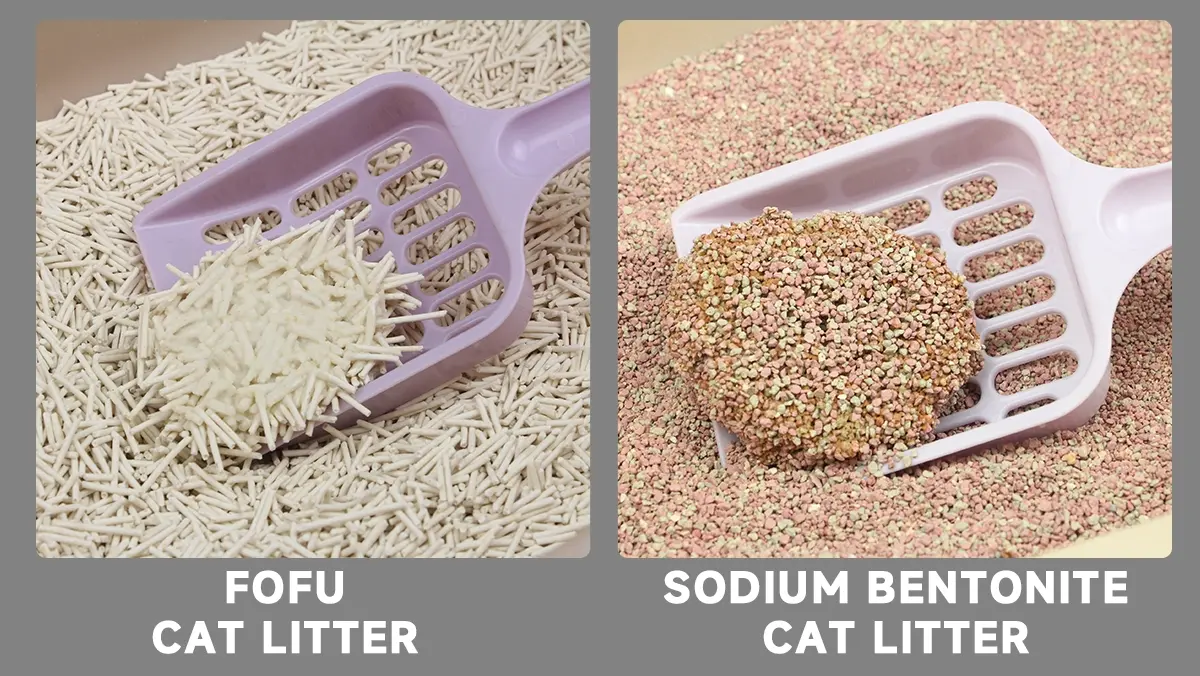
Tofu and bentonite cat litter account for most of the world's litter sales, yet they behave nothing alike in the tray. One is a plant pellet that breaks down in water; the other is a mineral granule that swells and binds. The choice is less about which is better and more about which one your market will repeat-buy.
The short answer
- Tofu if your market buys on sustainability, sells into flats and small apartments, or needs a flushable claim.
- Bentonite if it buys on performance first: hard clumps, ammonia control, lower price per kilo.
- Both if you are building a range. Most brand owners we supply end up with a mineral hero SKU and a plant-based second, because the two attract different customers rather than cannibalising each other.
Why they behave differently
Tofu litter is extruded, not mined. Pea fibre and corn or pea starch are mixed with a binder such as guar gum, pushed through a die and dried. Clumping comes from the starch gelatinising as it takes up liquid, which is why plant clumps flex rather than set, and why the drying step decides whether a bag survives a container.
Bentonite is a mineral product. Sodium bentonite is dominated by montmorillonite, a clay formed from volcanic ash, whose layered structure draws water between its sheets. That produces the swelling, the absorption and a clump that holds. Sourced and processed well, it is the hardest-clumping litter available.
Nine dimensions that decide the sale
| Dimension | Tofu (plant-based) | Bentonite (mineral) |
| Main raw material | Pea fibre, corn or pea starch, guar gum | Natural sodium bentonite (montmorillonite) |
| Clumping | Soft to medium, holds but flexes | Hard, high-strength, minimal breakage |
| Absorption | Moderate | High - swells on contact |
| Dust | Low when dedusted during production | Grade-dependent; low-dust grades available |
| Odour control | Relies on additives - carbon, soda, fragrance | Ammonia binding through ion exchange |
| Flushability | Marketed as flushable; check local rules | Not flushable |
| Tracking | Low - larger pellets | Moderate to high - fine granules |
| Weight per litre | Light | Roughly double |
| Cost position | Mid to high | Low to mid, lower per litre |
Figures vary by supplier and formula. Ask for the test method and the report, not the catalogue number.
The numbers worth trusting
A supplier quoting 500% absorption tells you nothing until you know the basis. Ask what was absorbed (distilled water and synthetic urine differ), how it was measured, and whether the result is expressed per 100g - the only figure that compares across suppliers.
There is no universal clump-strength index either. Reputable makers test drop resistance or compressive strength and will tell you which. A number without a method is a marketing number.
Odour, dust and tracking
Bentonite's advantage is chemical rather than cosmetic. Ammonium ions bind to the clay's negatively charged surface, so ammonia is held instead of perfumed over - which is why mineral litter still holds at day three, when a weak plant litter starts to show. Tofu has no mechanism of its own: odour control comes from what the maker adds, whether carbon, bicarbonate or fragrance, and that dosage is the first thing a cost-down exercise cuts.
Dust can be removed during granulation and screening, or sifted out of the finished product and hoped over. Ask which stage. Tracking follows particle size: fine mineral granules travel on paws, larger tofu pellets mostly stay in the tray.
Flushability
Plant litter disperses in water and is widely sold as flushable, but whether it belongs in a toilet depends on plumbing, septic systems and local rules - some markets restrict it outright. Write the claim to fit the destination, not the supplier's brochure. Home composting carries its own caveat: soiled litter carries pathogens.
Cost per litre, not per kilo
Bentonite is roughly twice the density of tofu, which changes how many litres land per container. A cheaper mineral litter can cost more per litre of shelf product; a cheaper plant litter can cost a container in rejected goods if moisture is not controlled.
Ask every supplier for cost per litre landed, at your packaging size. Then add the two costs no quote shows: a rejected container, and switching supplier mid-season.
What to check before you commit
1. Does the clay contain added lime or activators? Some low-cost clays are dosed with quicklime to speed clumping. That reaction is exothermic and is not something you want against a cat's paws. Ask for the formulation declaration.
2. Does the plant litter carry a formaldehyde declaration? Some binders and mould inhibitors used in low-cost plant litter can introduce it. Ask for a finished-product report, not a raw-material one.
3. What is the finished moisture, and measured where? This is the failure mode that kills plant litter in ocean freight.
4. Does a batch record travel with the container? A sample is made by hand or pulled from the best run of the month.
Conclusion
Performance-first markets: bentonite wins on clumping, ammonia and cost per litre. Story-first markets: tofu wins on sustainability, tracking and flushability. Most ranges need both.
MIYA makes both - from our own bentonite deposit in Balikun, Xinjiang, and our own plant in Zhengzhou - so the comparison above is between our own two lines rather than a defence of one.
See sodium bentonite cat litter → See tofu cat litter →
FAQ
Is tofu litter really flushable? It disperses in water and is widely marketed as such, but check the destination's plumbing and rules before printing the claim on a bag.
Which is better for a multi-cat household? Mineral, generally. Ammonia load is higher with multiple cats, and bentonite binds it rather than masking it.
Why does some cheap bentonite feel warm when it clumps? Some low-cost clays are dosed with quicklime or similar activators, and the hydration reaction releases heat. It is a formulation choice, not a property of bentonite. Ask any supplier whether theirs contains an exothermic additive.
By Ella, Export Manager at MIYA. We supply both categories with samples and test reports matched to your spec.